
Why Have Fun On A Budget

by Guest on December 21, 2009

why have fun on a budgetMost people, when they are on a budget, believe that pain and suffering is the result of being on a budget. That is so far from the truth. The pain and suffering is due to the fact that you don’t live by your budget and the money problems start coming.

We all know that you can only live so long if you are spending more money each month than your income. You can live on your credit cards or other personal loans for so long until they finally catch up with you. Then you not only not have the extra money you have been spending each month, but now you have to start paying back what you have already spent.

So, living on a budget is a smart thing to do. We should all agree to that by now. But why should you have fun while on a budget? If you don’t build some fun into your budget, you will not live on it very long. Without recreation and excitement in our lives, we will start to crave something to do or something to buy or somewhere to go, and that usually involves spending money we don’t have. Someone will invite you out to dinner, or you really feel you deserve a vacation, or that new entertainment system is just the thing you need right now. You look at yourself and how much work you have been doing and talk yourself into spending that money because you deserve it.

Well, there goes the budget. You fell right back into the same rut that you were trying to get out of when you started your budget. Then the guilt falls on you and you just give up trying.

Don’t let this happen to you. Build some fun money into your budget to take the edge off of your desires. Even if you have to scrape by on another category, you need to have some money for fun. It will do you and your family a great service. And, don’t feel guilty about it either, you do deserve some extra things in your life, just make sure you plan for them in advance.

You will be glad you did when the end of the month comes and you have stayed on your budget. Just remind yourself that things will get better when the old debts are paid off and you can start enjoying the extra money you have worked so hard to get.

About the Author

Greg Walding has gathered lots of information about personal finances at his website at http://www.extremepersonalfinance.com. Come to see what you can learn here.

Share

Prioritizing Your Bills

by Guest on November 21, 2009

when going through tough times, pay the most important bills firstMany times when we experience a drop in income, it is difficult to know what bills to pay first. You must know which bills are essential to your survival and which are not. There are basically three categories of bills: essential, nonessential and borderline. The biggest mistake you can make when going through financial difficulties is to pay the creditor who is yelling the loudest first. It is important to prioritize your bills when allocating how much money you have to work with. Whether you are having problems paying your bills or not this will help you take control.

The first step in prioritizing your bills is to know exactly how much income you have and how much you are spending per month. Keep a journal of all your expenditures. This includes the trip to the ATM machines, your gourmet coffee drinks, and the trips to the fast food restaurant. Write down every penny you spend for thirty days. You will be surprised at how much you can cut back and apply to your debt. Once you see where your excess spending is going, begin adding the extra money to your bills.

Essential bills are defined as survival and should be paid first. Mortgage or rent payments, utility bills, and food are included in the essential category. The next would be mandatory insurance such as car insurance. Medical needs could also be put into this category. Child support and any loans such as automobiles, furniture, and so forth that are secured or used as collateral to obtain the loans should be included with the essential bills.

Nonessential bills are debts in which no immediate consequences could occur if paid late. They are unsecured and include credit and charge cards, attorney, medical and accounting bills, and newspaper and magazine subscriptions. These should be paid after all the essential bills are paid.

Borderline bills can fall into either essential or nonessential categories. You are the only one who can determine which one. Borderline bills may include such things as life insurance, private schools, child daycare, health clubs, gyms, country clubs, clothing or court judgments. When reviewing your borderline bills you must move them over to either the essential or nonessential category.

By prioritizing your bills in the order of what should be paid first, you will begin to get in the habit of making sure your essentials are always paid first before running into a money shortage.

About the Author

Deborah McNaughton is an author and credit expert. She is founder of Financial Victory Institute, which specializes in financial education. Deborah has programs to train individuals to become credit consultants and teach financial seminars. Visit http://www.financialvictory.com or call 714-993-1171.

Share

never give up - you can take charge of your financesAlthough you may have failed at managing your money wisely in the past, it’s never too late to start to develop good habits.  Whenever you begin to feel it’s a losing battle or that there is just no way you can make ends meet let alone save for your retirement, think of WD-40.

For those of you who have never heard of it, WD-40 is a spray designed to repel water and prevent corrosion. It’s creator, Norm Larsen, invented WD-40 in 1953 after 40 attempts!  That means he failed 39 times before finally getting it right!  He was persistent.  If he had given up, the world would never have been able to benefit from such a product.  In the same way, you cannot afford to give up on developing good money management skills.  Giving up is not the answer.

There are many ways you can improve your money habits.  You can meet with a financial planner at your local financial institution and they can crunch some numbers and help you to create feasible goals for yourself.  You can create a budget and stick to it, and you can also read books and Internet articles that will give you ideas on how to save money and invest it wisely.

Although it will take discipline now and mean that you will be making some sacrifices in the present, you will reap the benefits in the future.  The sooner you start getting your finances in order, the better off you will be.

Share

use Microsoft Excel to keep track of your household budgetLooking after domestic finances can cause much anxiety. Often you are anxious because you find it difficult to keep track of your finances and so do not feel you are in control. Using Microsoft Excel to record, monitor and control your domestic finances can go a long way to removing this anxiety. Some effort is required at the beginning to set up the systems but this is soon rewarded by providing you with a great time and labour saving device, which can also help you save money and stay in control of your finances.

Home Maintenance

It can be very difficult to keep track of the maintenance requirements in the home, who can remember exactly when the boiler was last serviced for example. Microsoft Excel has the facilities to allow you to produce a home maintenance schedule to make keeping track of maintenance issues much easier. Each item that requires inspection can be listed, together with a schedule of how often they require checking. Simple functions are available in Excel to allow items that are overdue to be flagged for attention, for example by changing the colour to red if the inspection date has been missed. It is also very simple to add notes recording what the issues where the last time the item was inspected. The cost of any work done can also be recorded, which will help to highlight when it would be more economic to replace items rather than continue to repair them.

Household Budget

Keeping track of the household finances can be a daunting task. As well as the basic calculation functions, Microsoft Excel contains simple formulas, which will automatically update the results of your calculations when values change. Revising a value once the total has been calculated is simple, just make the change and Excel updates the total for you. There are also simple functions to allow you to add values, calculate averages and find the smallest or largest values in a range of values. You can use these functions to develop spreadsheets to keep track of all your incoming and outgoing payments, putting in predicted values of bills for budgeting purposes that can then be easily updated when the actual bill arrives. This allows you to keep track of your balance and helps you identify when there is likely to be a shortfall, giving you time to put measures in place to prevent charges being incurred.

Tax Returns

Filling in your tax return can be a long and drawn out business. Even if you send your return off to be completed by someone else you can make things significantly easier by keeping track of expenses during the year. Having a household budget spreadsheet at your fingertips makes it much simpler to record expenses and document the corresponding receipts, which you need to have to hand at tax return time.

Home Improvements

You can also use Microsoft Excel to help in planning and monitoring any home improvements. The first, and ultimately most important point to consider when starting such a venture is how much it is going to cost you. An Excel spreadsheet is a great tool for tracking expenses. You can use the spreadsheet to help you plan the works, develop a preliminary budget, record your actual expenses and compare them to each other. In this way if things are starting to go over budget you should be able to spot it early and use the spreadsheet to review your options to get it back on track.

The above points illustrate just a few of the many ways in which Microsoft Excel can be used to simplify many domestic finance tasks. By applying some or all of these measures you should feel more in control of the situation. You should also be able to save both time and money in completing your household duties, leaving you more time and money for the more enjoyable things in life!

About the Author

Author is a trainer with a Microsoft Office Training company, the UK industry leader in its sector. For more information on Microsoft Office Training, please visit http://www.microsofttraining.net/excel-training.php

Share

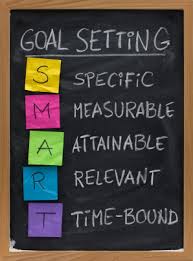
set goals for the short, medium, and long termEvery one should have goals. If you don’t have goals, it’s a good idea to make some because when you set goals, you have something to measure your achievements against.  Although most of us do have goals, we don’t all set up goals for the short, medium, and long term.  We may only set short-term goals or perhaps we might just think about our retirement.

A short-term goal might involve saving for a much-needed vacation within the next year or perhaps saving up to buy a vehicle.  A medium-term goal could be to save money for a down payment on a home, and a long-term goal could be to save for retirement or for your child’s education.  By setting goals for different timeframes, you are more likely to achieve your dreams by following a disciplined approach.

Short-term goals such as saving for a vacation could be as simple as putting money into a locked-in account such as a GIC or investing in something like a Money Market or T-Bill.  This way your capital is secure and you can still see some growth in your investment.

A medium-term goal such as saving up to buy your first home could be achieved by setting up an RRSP and taking advantage of the Home Buyer’s Plan.  You could set up preauthorized payments into the RRSP on the same day you get paid and over time your money will grow.

An example of a long-term goal would be a couple who just had their first child  They decide that it is important to them to fund their child’s future post secondary education.  They set up an RESP (Registered Education Savings Plan for Canadians) and begin to contribute to it monthly.  By doing so, they have time on their side and their funds have the time to grow enough to adequately provide the funding for their child’s education.  Had this couple not had the foresight to set up the RESP right away, they would have had to come up with a lot more cash to help out their child.

Planning ahead and disciplining yourself to put money aside each month to contribute to funding your short, medium, and long-term goals is well worth it.  Although you might feel that you are on a tight budget, you can take comfort in knowing that you are paying yourself first, and that your scrimping and saving will pay off as you achieve more and more of your goals.

Share

Today more than ever, it is important to learn the basics of personal financial management. With the costs of nearly everything rising, it is crucial to learn how to set and stick to a budget, pay off debts, and save for the future. There are many small things you can do that will contribute greatly to helping you with your own personal financial management.

The easiest way to do this is by learning how to make the most out of the money you earn. Earning more money will not help you in the end, because you will only end up spending more if you do not learn an effective way to handle your personal financial management. You must learn the difference between what you want and what you need, and how to prioritize them both. It takes self control to live within your means, and to know when you can afford something, and to walk away from it if you cannot. But that is what it takes to make the most of your income.

Your budget should include money set aside for emergencies, expected purchases, living expenses, and bills. Setting a small amount out of each paycheck aside for unexpected emergencies, such as illness or car repairs, will save you from having to possibly pay interest on a loan to take care of your problem. Taking it out of your check allows you to prepare ahead of time, and keeps you from having to come up with a lump sum of money all at once, hopefully, preventing you from incurring more debt.

If you know you need to make a large purchase in the near future, such as a new washing machine, or a new computer, plan ahead, and set aside money for that item from each check as well. Once you have saved enough money, shop around for the best deal. Try to never make a large purchase unless you can do it with cash, to avoid paying high interest and fees.
[click to read…]

Share

Emergency Fund – How Much Is Enough?

by Pam on August 13, 2009

Most people are familiar with Suze Orman’s advice about saving up 8 months worth of living expenses as an emergency fund.  It seems like an awful lot of money, but I can definitely see her point.  Especially in this troubled economy when it’s possible to lose your job and it’s better to have a cushion of money to keep you going while you are looking for another one.  But, when the economy is at its best, do we really need 8 months worth? And if not, how much is enough?

I think it should be a personal choice.  You know what you can comfortably live on.  (If you don’t I would recommend making a budget so you can track how much you spend.) It definitely is a good idea to have some cash on hand in the event of a roof leak or an emergency root canal procedure.  But if an amazing investment opportunity comes your way that is too good to pass up, you may decide to forfeit part of your emergency fund.  That’s okay, as long as you have something else to rely on such as a low interest credit line.  You always want to make sure that you have something to fall back on that won’t charge high interest rates (i.e. you don’t want to have to rely on credit cards.)

If you are unsure about how much you should be saving, you might want to ask yourself this question:  If the worst possible scenario happened to me right this minute, how much money would I need to keep my family going?  No one can really tell you the perfect amount to have saved up for a rainy day.  The point is that it’s important to always have some tucked away.

Share