

Investing

How Much Should I Contribute to my RRSP?

how much should I contribute to my RRSP?


We are all becoming more and more aware of the importance of saving for retirement.  Unfortunately, many people have no idea how to go about it.  Some people say it’s best to try to max out your RRSP (Registered Retirement Savings Plan) contribution space each year.  I disagree.  Instead, I recommend contributing enough to take advantage of a lower tax bracket, and then contributing to a TFSA (Tax Free Savings Account) or a non-registered investment account (IA) to supplement additional retirement savings.

I say this because the main advantage of contributing to an RRSP is the tax deduction and the tax-deferred growth.  If contributing $4000.00 in a given year brings you to a lower tax bracket, there is no need to contribute anymore than that since you have already maximized the tax benefits.

On the other hand, that doesn’t mean that you shouldn’t be building up your retirement savings in other ways such as by contributing to your TFSA (up to $5000 of additional contribution space is added each year) and/or contributing to a non-registered investment account.

Once you’ve determined how much you need to contribute to your RRSP, if you still have funds remaining that can be used for retirement savings, I would suggest building up your TFSA, because you don’t have to calculate your capital gains or losses, and more importantly, you don’t have to pay tax on your earnings.  It is also much easier to withdraw from a TFSA if the need arises.

Before deciding on how much to contribute to your RRSP, I would highly recommend checking out  http://www.cra-arc.gc.ca/tx/ndvdls/fq/txrts-eng.html on the Canada Revenue Agency website to see exactly how much you should contribute to maximize your tax benefit.  After that, if you still have room in your budget, consider putting some money into a TFSA and then an IA and set yourself up for success.

For more detailed information on RRSP related topics, check out my RRSP Page.  You can also check out my e-book about RRSPs.
Book Reviews

Read Money Money Money To Your Kids – You Will Love It, Too!

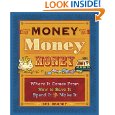
teach your kids about money by reading Money Money Money to themMoney Money Money: Where It Comes From, How To Save It, Spend It, And Make It by Eve Drobot

I often come across books about money in our public library’s online catalogue, and I don’t always pay close attention to what I request.  As long as it’s something to do with saving or investing money, I think it might be worth my time to read.  Imagine my surprise when I took my first glimpse at Money Money Money.  It’s a children’s book!  Although I have to admit I do enjoy reading children’s books from time to time, I really didn’t have a lot of expectations after seeing the cover.
Well, I was proved wrong in judging this book by its cover.  Money Money Money is a fantastic children’s book.  I had no idea that anyone had written such a thorough account of money for children.  It’s full of interesting facts about money, including its history, how its made, and its future.  I can safely say that I absolutely enjoyed reading it and I bet many other adults would enjoy it as well.

It’s full of illustrations and graphics showing all different types of currencies.  There’s a picture of the oldest paper currency ever used as well as the first coins ever made.  Near the beginning, the author suggests that her readers set up a system of 3 jars for their savings.  One jar should be for short term spending such as candy and watching movies, the second jar should be for saving for a bigger purchase such as a video game, and the third jar should be used for saving money to give away to others.

I think every parent should teach their children about money so they have a healthy understanding of how to manage their money when they are on their own.  I highly recommend that you read this book to your children or grandchildren.   I can guarantee that you won’t be bored.  In fact, you may even appreciate it more than your kids. This book will instill into your kids a better understanding of what money is and where it came from, as well as the importance of saving and spending wisely.

To give you an idea of some of the interesting facts found in this book, here are some tidbits:

Did You Know?

*The Canadian one-dollar coin, referred to as the “loonie” was initially supposed to show a French explorer and a Native guide paddling a canoe.  En route to the Mint, they were somehow lost.  The government was afraid of possible fraudulent activity so rather than continuing to use the same design, they decided to use a diving bird called the loon.  Hence, the one-dollar coin is called a “loonie”.

*The Chinese were the first to use paper money and they started using it as far back as 2000 years ago.

*Chinese coins used to have a hole in the middle so they could be tied onto a string.  A bundle of one hundred coins on a string was referred to as one cash.

*Canadians refused to accept a $1 bill printed in 1954 because part of Queen Elizabeth II’s hair around her ear appeared to look like the devil.

Household

Ways To Save Money on Your Heating Bill

ways to save money on your heating bill this winterHere we go again. Winter will soon be here along with its snow storms and freezing cold weather.  If you’re like me, you’re probably not looking forward to the increased heating costs.  Below are some suggestions of ways to reduce your heating costs this winter.  Stay warm!
1.  Replace your furnace filter every couple of months to ensure your furnace is running efficiently.

2.  Have your furnace cleaned every 2 to 3 years to maximize its efficiency.

3.  Insulate your water heater with a water heater jacket.

4.  Turn down the water heater temperature to approximately 50 degrees to conserve energy and save money.

5.  Limit the use of bathroom and kitchen fans as they blow the warm air out of your home.

6.  Check for drafts around your windows and doors.  Use caulking or weather stripping to seal any openings.

7.   Insulate your windows with window plastic.

8.  Keep your blinds open during the day to let the sunshine warm the house.  Once the sun goes down, close the blinds to further insulate your windows.

9.  Before cranking up the heat, make sure you are wearing warm socks, slippers, and sweaters.   Don’t be afraid to walk around wrapped in a fleece blanket either.  Fleece blankets are a lot cheaper than your heating bill is ever going to be.

10.  Make use of a programmable thermostat.  Set it so that the temperature is lower when you are away from home as well as during the night.

11.  To learn about more than 100 ways to save on your energy bill, check out this link.

Budgeting

Prioritizing Your Bills

when going through tough times, pay the most important bills firstMany times when we experience a drop in income, it is difficult to know what bills to pay first. You must know which bills are essential to your survival and which are not. There are basically three categories of bills: essential, nonessential and borderline. The biggest mistake you can make when going through financial difficulties is to pay the creditor who is yelling the loudest first. It is important to prioritize your bills when allocating how much money you have to work with. Whether you are having problems paying your bills or not this will help you take control.

The first step in prioritizing your bills is to know exactly how much income you have and how much you are spending per month. Keep a journal of all your expenditures. This includes the trip to the ATM machines, your gourmet coffee drinks, and the trips to the fast food restaurant. Write down every penny you spend for thirty days. You will be surprised at how much you can cut back and apply to your debt. Once you see where your excess spending is going, begin adding the extra money to your bills.

Essential bills are defined as survival and should be paid first. Mortgage or rent payments, utility bills, and food are included in the essential category. The next would be mandatory insurance such as car insurance. Medical needs could also be put into this category. Child support and any loans such as automobiles, furniture, and so forth that are secured or used as collateral to obtain the loans should be included with the essential bills.

Nonessential bills are debts in which no immediate consequences could occur if paid late. They are unsecured and include credit and charge cards, attorney, medical and accounting bills, and newspaper and magazine subscriptions. These should be paid after all the essential bills are paid.

Borderline bills can fall into either essential or nonessential categories. You are the only one who can determine which one. Borderline bills may include such things as life insurance, private schools, child daycare, health clubs, gyms, country clubs, clothing or court judgments. When reviewing your borderline bills you must move them over to either the essential or nonessential category.

By prioritizing your bills in the order of what should be paid first, you will begin to get in the habit of making sure your essentials are always paid first before running into a money shortage.

About the Author

Deborah McNaughton is an author and credit expert. She is founder of Financial Victory Institute, which specializes in financial education. Deborah has programs to train individuals to become credit consultants and teach financial seminars.

Debt

Is It Better To Pay Off Your Mortgage or Contribute To Your RRSP?

should I pay off my mortgage or contribute to RRSPs?This is an age-old question and after doing some research on the subject, I have discovered that there are a lot of differing opinions out there.  Some say you should pay off all your debt before contributing to an RRSP, while others suggest making RRSP contributions when you are young and then focusing on paying down your mortgage when you are older.

The answer to this question, however, really depends on you and your own personal comfort with debt.  There are a lot of people out there who absolutely despise being in debt and will do everything in their power to get out of debt, while others are okay with being in debt, at least to a certain extent.

When considering what to do, it’s a good idea to talk to a tax specialist and/or a financial planner.  Sometimes people end up doing ridiculous things in order to avoid paying tax, so it’s important to consider all aspects rather than simply focusing on reducing the amount of tax you pay.

Some specific things to consider when choosing between saving for retirement and paying off your mortgage include your age, current tax bracket, investment returns, mortgage interest rate, and whether or not you have a pension plan.

After skimming through several articles on this subject, I noticed that most people suggest doing both.  That way you will feel as if you are getting somewhere, since simply paying down debt is supposedly not as psychologically satisfying.  Another opinion I stumbled upon was that it’s better to pay off your mortgage first if your mortgage interest rate is equal to or higher than your RRSP’s rate of return.

It really all boils down to what you deem is most important for your own personal situation.  If you want to read chartered accountant David Trahair’s opinion on why you should pay off your mortgage before contributing to an RRSP, check out this link.

If you have come across some extra money due to an inheritance, etc., I would encourage you to do your own research prior to making a decision.  There are pros and cons to both sides and it may be wise to do both simultaneously.  As the saying goes, it’s not a good idea to put all your eggs in one basket.  On the other hand, sometimes it makes the most financial sense to choose one over the other.