
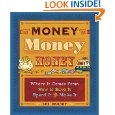
 Money Money Money: Where It Comes From, How To Save It, Spend It, And Make It by Eve Drobot
I often come across books about money in our public library’s online catalogue, and I don’t always pay close attention to what I request. As long as it’s something to do with saving or investing money, I think it might be worth my time to read. Imagine my surprise when I took my first glimpse at Money Money Money
Well, I was proved wrong in judging this book by its cover. Money Money Money is a fantastic children’s book. I had no idea that anyone had written such a thorough account of money for children. It’s full of interesting facts about money, including its history, how its made, and its future. I can safely say that I absolutely enjoyed reading it and I bet many other adults would enjoy it as well.
It’s full of illustrations and graphics showing all different types of currencies. There’s a picture of the oldest paper currency ever used as well as the first coins ever made. Near the beginning, the author suggests that her readers set up a system of 3 jars for their savings. One jar should be for short term spending such as candy and watching movies, the second jar should be for saving for a bigger purchase such as a video game, and the third jar should be used for saving money to give away to others.
I think every parent should teach their children about money so they have a healthy understanding of how to manage their money when they are on their own. I highly recommend that you read this book to your children or grandchildren. I can guarantee that you won’t be bored. In fact, you may even appreciate it more than your kids. This book will instill into your kids a better understanding of what money is and where it came from, as well as the importance of saving and spending wisely.
To give you an idea of some of the interesting facts found in this book, here are some tidbits:
Did You Know?
*The Canadian one-dollar coin, referred to as the “loonie” was initially supposed to show a French explorer and a Native guide paddling a canoe. En route to the Mint, they were somehow lost. The government was afraid of possible fraudulent activity so rather than continuing to use the same design, they decided to use a diving bird called the loon. Hence, the one-dollar coin is called a “loonie”.
*The Chinese were the first to use paper money and they started using it as far back as 2000 years ago.
*Chinese coins used to have a hole in the middle so they could be tied onto a string. A bundle of one hundred coins on a string was referred to as one cash.
*Canadians refused to accept a $1 bill printed in 1954 because part of Queen Elizabeth II’s hair around her ear appeared to look like the devil.
 Here we go again. Winter will soon be here along with its snow storms and freezing cold weather. If you’re like me, you’re probably not looking forward to the increased heating costs. Below are some suggestions of ways to reduce your heating costs this winter. Stay warm!
 Many times when we experience a drop in income, it is difficult to know what bills to pay first. You must know which bills are essential to your survival and which are not. There are basically three categories of bills: essential, nonessential and borderline. The biggest mistake you can make when going through financial difficulties is to pay the creditor who is yelling the loudest first. It is important to prioritize your bills when allocating how much money you have to work with. Whether you are having problems paying your bills or not this will help you take control.
 This is an age-old question and after doing some research on the subject, I have discovered that there are a lot of differing opinions out there. Some say you should pay off all your debt before contributing to an RRSP, while others suggest making RRSP contributions when you are young and then focusing on paying down your mortgage when you are older.
 A Registered Disability Savings Plan (RDSP) is a relatively new plan offered by the Canadian government that is intended to help parents and others to save money for people who are eligible for the Disability Tax Credit. The plan is designed for long-term savings and it’s best to keep any contributions in the plan for at least 10 years.