
Credit Cards

Are You Underestimating Your Credit Card Debt??

Learn How to Get Rid of Debt the Easy Way

Have you fallen into this trap? Repeatedly, reliable survey sources tell us that most of us do not realize how much we spend every month using our credit cards. Investigations reveal that when consumers thought their total credit card debt was about $20,000, in fact it was closer to $40,000. Scary difference – consumers are spending a lot more than they think! When we routinely pay for everything with the plastic card and don’t keep track of what we spend, these careless spending habits all too often lead to debt problems – problems which can easily be avoided.

To add to the problem, most of us have several credit cards, so if you use them to pay for everything, then you also transfer the balances from time to time to get a better interest rate, it’s easy to miscalculate how much you’re spending. With so many credit cards and with so many different payment options, it is easy to see how overspending can occur.

Six out of ten consumers don’t even know their account balances, so funds could be withdrawn in fraudulent transactions without them even realizing it! Now if you don’t keep track of your money, who else is going to? So what you need to do, if you haven’t done so already, is sit down and get an understanding of where you stand with your credit card debt. Double check what’s coming in and what’s going out, make sure everything balances at the end of the month, then continue to keep a tighter grip on your accounts.
Continue Reading

Banking

Evaluate Your Bank Accounts

It is really important to take a close look at your current banking products to see if they are working for you.  For instance, if you look at your bank statements for the past few months, are you being charged monthly fees or transaction fees?  If so, contact your financial institution to see if they have a product that meets your needs that doesn’t charge fees or that is more suited to your use of the account.  Often financial institutions improve their products and it is up to you to make the most of these improvements.  Although you will often receive mailings from your bank or credit union, if you don’t pay attention, you could miss out on something that could benefit you.  That’s why it’s important to ask!!!

If you are a student or a senior citizen, check with your financial institution to see if they have products specifically designed for you.  Often seniors and students qualify for products without any banking fees.  Don’t be passive when it comes to banking.  Always look at your statements or better yet, sign up for online banking so you can keep on top of things.  Ask for a fee schedule so you are fully aware of the limitations (if there are any) on your account.  With a little work on your part, you can minimize (if not eliminate) your banking fees.

Family

Teach Your Kids About Money

Whether you like it or not, if you are a parent, you are a role model for your kids.  Your kids observe the way you handle your money and will often handle theirs the same way.  However, even if you are financially savvy, your kids won’t necessarily be as successful without some guidance starting at a young age.

Here are some things every kid should learn about money from their parents:

1.  Money doesn’t grow on trees.  Parents have to work hard for every dollar they earn.

2.  Parents have priorities for their money.  It needs to be used first for food, shelter, clothing, and savings, and whatever is left can be used for extras.  Kids have to learn that they cannot always get what they want.

3.  Teach your kids the value of giving.  Encourage them to give part of their allowance to a charity or sponsor a child as a family.

4.   Teach your kids the value of hard work.  Have your children do some small chores around the house in order to earn their allowance, rather than just handing it to them.  

Continue Reading

Book Reviews

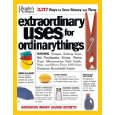
Reader’s Digest Extraordinary Uses for Ordinary Things

Extraordinary Uses For Ordinary ThingsWhile searching for interesting books to read about saving money, I came across Reader’s Digest Extraordinary Uses for Ordinary Things: 2,317 Ways to Save Money and Time in our local library’s database.It is fantastic!This book would make a great reference book. It is full of suggestions on how to use common household objects to do all sorts of things. For example it talks about the many uses of aluminum foil, cat litter, and even old coffee grounds, to name a few. Although it would take many lifetimes to try everything out that it suggests, it does offer some simple and affordable solutions that are very practical and useful.I highly recommend that you check out this book if you are interested in learning how to make the most of the common, everyday objects lying around your home.You can save a lot of money, be environmentally friendly, and have a lot of fun when you get creative with your stuff!

Here are some examples of suggestions you will find in this book:

*Use denture tablets to make your diamond ring or earrings sparkle again by dropping a denture tablet into a glass of water. Put in your ring or diamond earrings and let sit for a few minutes. Rinse them off and they will look like new!

*Use ice cube trays to organize your workbench. You can use them to store small screws, nuts, bolts, etc.

*Use a piece of well-chewed gum to fill a crack in a clay flowerpot or your pet’s food dish.

*If you run out of shaving gel, use olive oil. It will make it easier for the blade to glide over your skin and it acts as a natural moisturizer.

Book Reviews

How The Rich Dad Books Impacted Us

My husband and I began  reading the Rich Dad Books by Robert Kiyosaki back in February of last year. After we started reading them we began to get excited and motivated. We realized that our lives don’t have to always be the way they are now – working full time for someone else, retirement at age 65, and a maximum of 2 to 3 weeks vacation every year. We realized that there really is a way to get out of the rat race and that we don’t have to be rich to begin the journey. So often we have heard the aggravating saying, “It takes money to make money”. Well, according to the Rich Dad books, that is not necessarily true. Instead of using our own money, we can learn how to use other people’s money (OPM) to make wise investments and to start viable businesses. I really like Robert Kiyosaki’s style of writing – he is easy to understand and he provides practical advice on how to manage money and to think like the rich. He is very encouraging and I admire his desire to help others achieve the kind of success that he has achieved.

Ever since we read those books our lifestyle has changed. We started to keep our eyes open for business opportunities – looking in newspapers, hearing about opportunities on the radio, etc. We attended a trade show where we were exposed to all kinds of investment/business opportunities and we went to an information session about investing in vending machines and another one on buying raw land. We continue to read books about investing and business to educate ourselves and keep us motivated. Through these experiences we are developing a new way of thinking – not limiting ourselves to remaining in the rat race for our entire lives. It is exciting to be able to look forward to the future and to believe that there are infinite opportunities out there.

If you are tired of being stuck in the rat race, I highly recommend that you read the Rich Dad books, starting with Rich Dad Poor Dad. I will write more on the individual Rich Dad books later, but thought I would start by sharing how this series has impacted us. We had always been fairly good with money – we knew how to save and we didn’t rack up consumer debt, however, we needed the encouragement and motivation to get started on our journey to get out of the rat race. I hope you enjoy the series as much as we did!